What the PAVA Framework engagement involved across product discovery and comparison-stage AI queries.
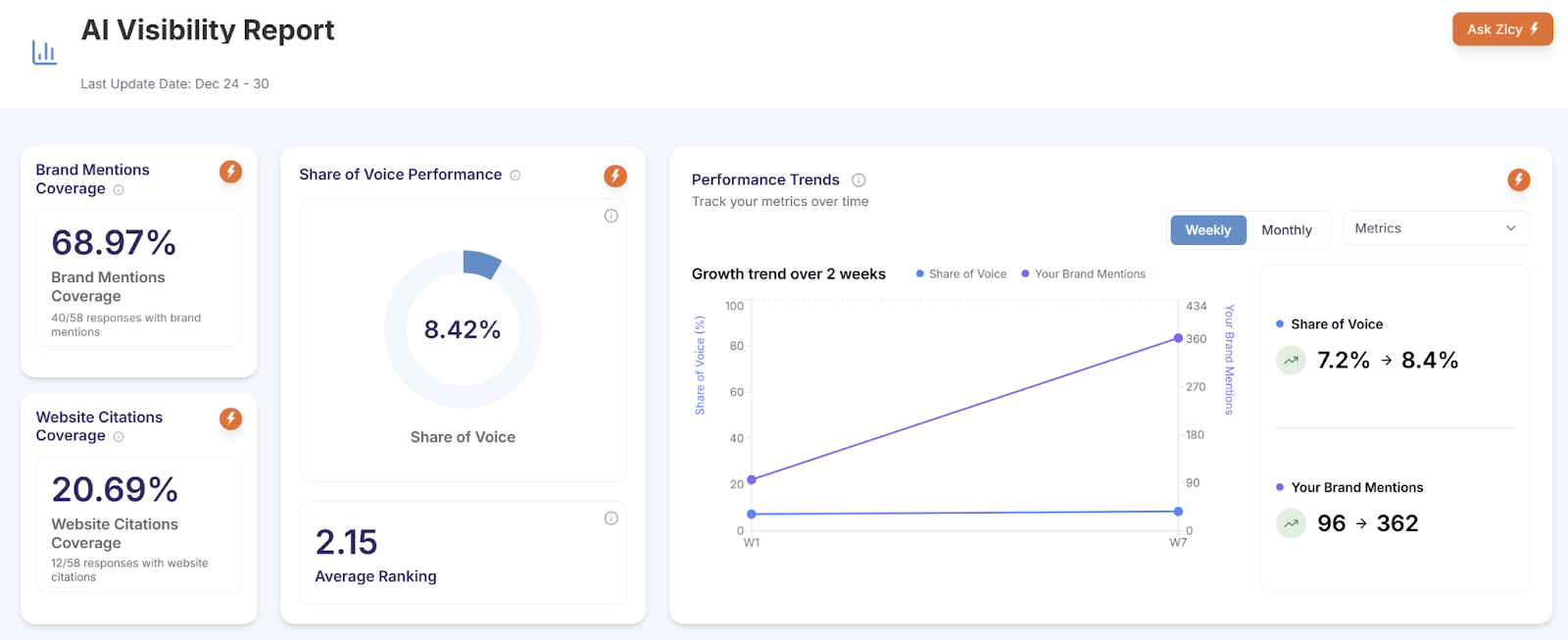
An eCommerce client engaged us last quarter with the same problem most consumer brands now face. Product discovery and comparison searches were quietly moving from Google’s results page to inside the AI platforms, and the brand had no visibility on whether AI was even mentioning it in the queries that drive product consideration. Across the engagement, AI-referred active users grew 1,119% year over year. Sessions grew 886%. The brand held 68.97% mention coverage and a 2.15 average ranking position across the tracked prompt set.
Below is what the work involved, and what I would take from it.
AI platforms have become legitimate entry points for product discovery. A consumer asking “best [product category] under [budget]” or “[brand A] vs [brand B] for [use case]” is doing the comparison work inside the chat window, then clicking through to a small number of named brands. The brands that get named win. The brands that do not, do not.
This client had a healthy traditional eCommerce funnel. SEO was performing. Paid social was performing. AI search was completely unmeasured. We baselined the brand across ChatGPT, Gemini, Perplexity, Google AI Overviews, and Google AI Mode against the high-intent commercial queries the brand’s buyers actually run.
The baseline picture: inconsistent presence across the priority prompt set. Competitors with weaker product positioning were getting cited more often. Where the brand did appear, it appeared inconsistently across platforms.
The engagement ran across all four pillars of the PAVA Framework: Presence, Authority, Visibility, Amplification. Each pillar addresses a question AI platforms appear to weigh before deciding whether to surface a brand in an answer.
-
PRESENCE. Entity integrity.
Product and collection pages were rewritten for unambiguous category positioning. Schema deployment covered organisation, product, offer, and review types across the catalogue. The brand description was aligned across LinkedIn, Crunchbase, and the relevant retail and category directories. Wikipedia work went through the standard contributor process with paid-contributor disclosure where the policy requires it.
-
AUTHORITY. Earned editorial standing.
We mapped the third-party publications AI platforms cite in this product category. Trade media, category review outlets, comparison sites that AI treats as authoritative. We briefed the client’s existing PR and partnership team against that target list with angle briefs aligned to genuine editorial opportunities. Citation outcomes measured against each placement.
This is what AI Citation Enablement looks like on the earned side. AICE is the discipline we run across all four PAVA pillars: making the brand’s expertise easier for AI to find, verify, and accurately attribute, on the brand’s own merits.
-
VISIBILITY. Content architecture.
We mapped the prompt universe, our term for the high-intent product discovery and comparison queries the brand’s buyers actually run on AI platforms. Product and category pages were restructured into the formats AI retrieval systems extract most reliably: direct answers at the top of product descriptions, comparison-logic framing on collection pages, clear use-case differentiation cues, and statistics sourced with publisher, sample, and year where applicable.
Comparison queries were the priority commissioning queue, because that is where product purchase decisions actually crystallise.

-
AMPLIFICATION. Sustained presence.
Continuous monitoring across all five named AI platforms. Weekly ranking-position tracking. Sentiment patterns across cited sources watched closely. Competitor density per prompt monitored. Where a competitor was gaining ground on a query cluster, reinforcement work was scheduled before the gap widened.
The 2-week visibility trend captured the compounding shape clearly. Share of voice moved from 7.2% to 8.4%. Brand mentions grew from 96 to 362. The trajectory was not driven by spikes. It was the natural compounding of presence work on a competitive base.
The Numbers
AI Visibility Metrics
- Brand mention coverage: 68.97% (40 of 58 responses)
- Citation rate: 20.69%
- Share of voice: 8.42%
- Average AI ranking position: 2.15
AI Traffic Growth (Year-over-Year, GA4):
- Active users: +1,119%
- Sessions: +886%
- ChatGPT active users: +1,140%
- ChatGPT sessions: +882%
- Gemini traffic: triple-digit growth
2-WEEK MOVEMENT:
- Share of voice: 7.2% → 8.4%
- Brand mentions: 96 → 362
COMPETITIVE POSITIONING:
- Average ranking: 2.15 (ahead of several competitors)
- Higher ranking consistency than brands with larger raw citation counts
- Competitors had higher raw citations but weaker ranking stability

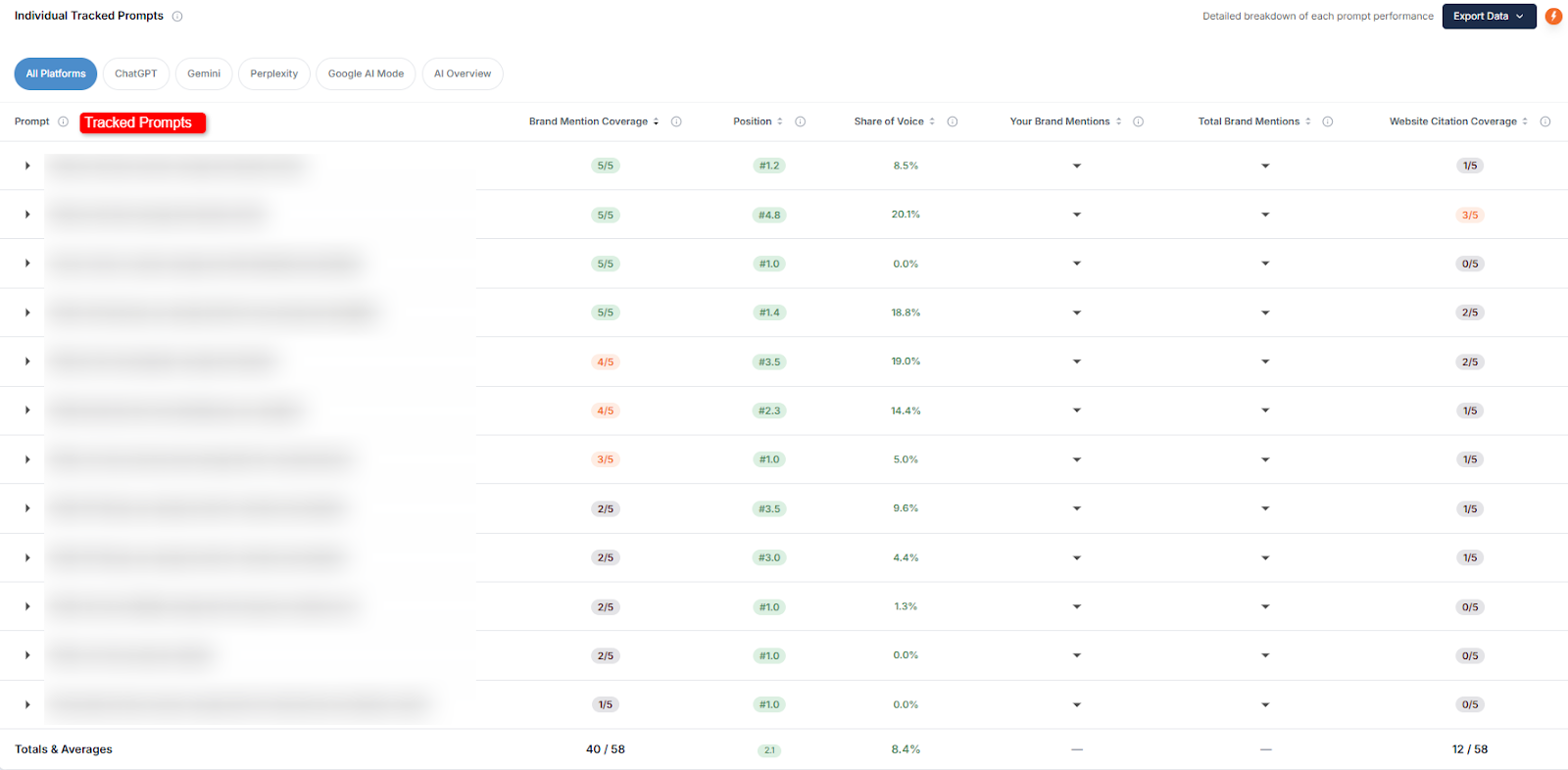
We measure outcomes against what we call the M-C-R stack: Mention, Citation, Recommendation. This engagement moved Mention coverage materially (68.97%) and is on the doorstep of the Recommendation tier with a 2.15 average ranking position. Recommendation rate, where the brand is the suggested choice in a commercial-intent answer, is the third tier and the next horizon for the measurement programme.
The 1,119% traffic growth number is real, but the more useful read is the ranking-consistency observation. Competitors on this engagement had higher raw citation counts. They lost on ranking stability. The brand that gets cited frequently but inconsistently performs worse than the brand that gets cited fewer times but consistently in top positions. Consistency is what AI rewards.
Three Observations
Ranking Consistency Outperforms Raw Citation Count in eCommerce
Competitors had higher raw citation numbers. The brand had higher ranking consistency and a better average position. That position is what drives the click-through into product pages. eCommerce programmes that optimise for citation count alone over-invest in volume and under-invest in stability. The 2.15 average ranking is the number that produced the 1,119% traffic growth.
The Comparison Query Is the Product-Discovery Battleground
Branded queries reward existing brand equity. Comparison queries reward AI presence. In product categories where the buyer is in active evaluation mode, “Brand A vs Brand B” prompts are where the purchase decision narrows from three candidates to one. We prioritised comparison-stage queries during the content work. That was the single highest-leverage choice on this engagement.
Product Pages Are Not Content Pages
The product and collection pages on most eCommerce sites are written for human persuasion, not AI extraction. Use-case framing, comparison logic, clear differentiation cues — these are the formats AI retrieval systems extract cleanly. Most eCommerce brands have spent fifteen years optimising product pages for conversion rate and zero time optimising them for AI summarisation. That gap is fixable on a per-page basis and produces compounding traffic when it closes.
What Was Not In Scope
The work explicitly excluded several practices. This matters in 2026 because Google’s May 15 spam-policy update on generative search formally classified most of them as spam.
- No paid placements with passing links. Any sponsored editorial carried rel=”sponsored” or rel=”nofollow”.
- No syndicated press release distribution with optimised anchor text.
- No anonymous Wikipedia editing on the brand’s behalf.
- No AI-generated content published at scale, including product descriptions.
- No incentivised or coordinated reviews on platforms AI reads.
These are not stylistic preferences. They are the line between sustainable AI visibility work and tactics that are about to be audited out of the market. In eCommerce specifically, the review-incentivisation line matters more than most other categories. Coordinated reviews on aggregator sites are about to come under heavier scrutiny.
In May we renamed our signature practice from “AI Citation Engineering” to “AI Citation Enablement”. The acronym (AICE) stayed, the framing changed. “Engineering” implies working on AI’s evaluation. “Enablement” describes working on the brand. The second framing is the only one I am comfortable defending in client engagements over the next two years.
Where To Start
If your eCommerce brand has not been benchmarked against the major AI platforms for the comparison-stage prompts that drive product consideration, that is the place to start. We run a complimentary AI Visibility Audit. It takes a week and produces a board-ready benchmark against your top competitors across all five major AI platforms, with ranking-consistency analysis surfacing where existing presence is unstable. The audit is the diagnostic phase of the AI Visibility Operating System we build for consumer brands.