What the PAVA Framework engagement looks like when the brand already has presence and the job is consistency.
A B2B service provider engaged us last quarter with an unusual starting position. They were already showing up in AI answers across their category. They wanted to know whether their presence was holding consistently, where it was slipping, and what it would take to lock in top-three positioning across the 130 high-intent prompts their buyers were actually running.
Most AI visibility case studies are about going from invisible to visible. This one was different. The work was about precision and reinforcement, not headline growth.
Below is what the work involved, and what I would take from it.
The Starting Position
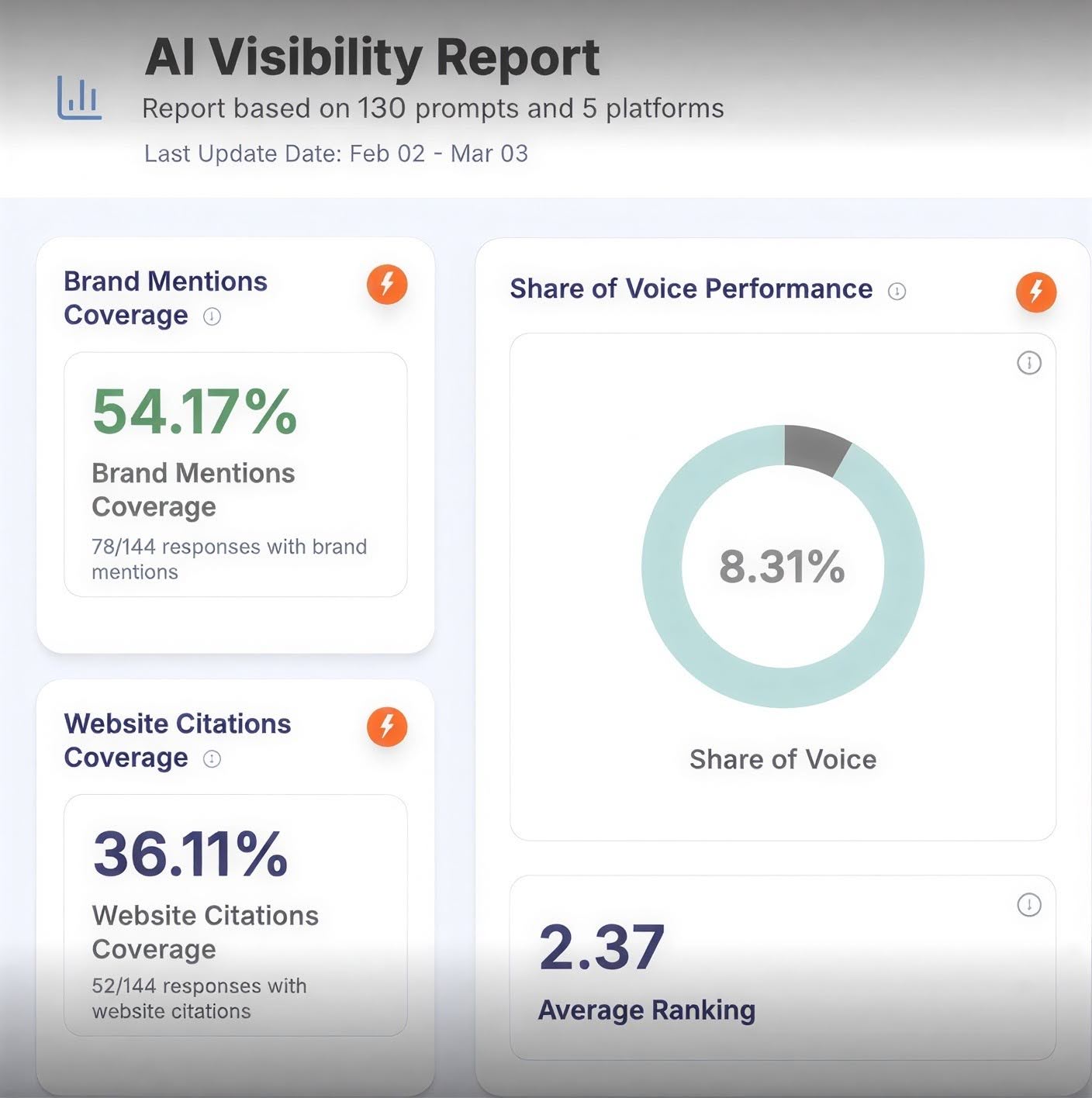
Most B2B brands engaging us are starting from low single-digit AI mention coverage. This client was different. They had already established meaningful AI presence in their category and were appearing in “best provider” searches and service-specific queries across the five major platforms. Mention coverage on the baseline audit was 54.17%, citation rate 36.11%, average ranking position 2.37.
The strategic question was not “how do we appear.” It was “where are we appearing inconsistently, and what does it take to hold the top-three position once we have it.”
We ran the baseline across ChatGPT, Gemini, Perplexity, Google AI Overviews, and Google AI Mode. We mapped 130 high-intent prompts the buyers actually run. We tracked ranking position fluctuation week over week to identify the prompts where presence was unstable.
The pattern was clear. Strong on “best provider” searches. Strong on service-specific prompts. Inconsistent on comparison queries and on prompts where competitor density was rising. That was the gap we set out to close.
What The Work Involved
The engagement ran across all four pillars of the PAVA Framework: Presence, Authority, Visibility, Amplification. Each pillar addresses a question AI platforms appear to weigh before deciding whether to surface a brand in an answer.
-
PRESENCE. Entity integrity.
Even with strong existing AI presence, the entity layer benefits from a refresh. Generic positioning language across service pages was tightened into definitional clarity. Attribution signals on core pages were reinforced. Schema deployment audited and cleaned up. Canonical brand description aligned across LinkedIn, Crunchbase, and the relevant industry directories. Wikipedia work went through the standard contributor process with paid-contributor disclosure where the policy requires it.
-
AUTHORITY. Earned editorial standing.
The brand already had reasonable trade-publication coverage. What it did not have was citation-outcome measurement on that coverage. We mapped which existing PR coverage was actually translating into AI citations and which was not. We briefed the client’s existing PR partner against an updated target list with angle briefs focused on the publications AI was already preferentially citing.
This is what AI Citation Enablement looks like on the earned side. AICE is the discipline we run across all four PAVA pillars: making the brand’s expertise easier for AI to find, verify, and accurately attribute, on the brand’s own merits.
-
VISIBILITY. Content architecture.
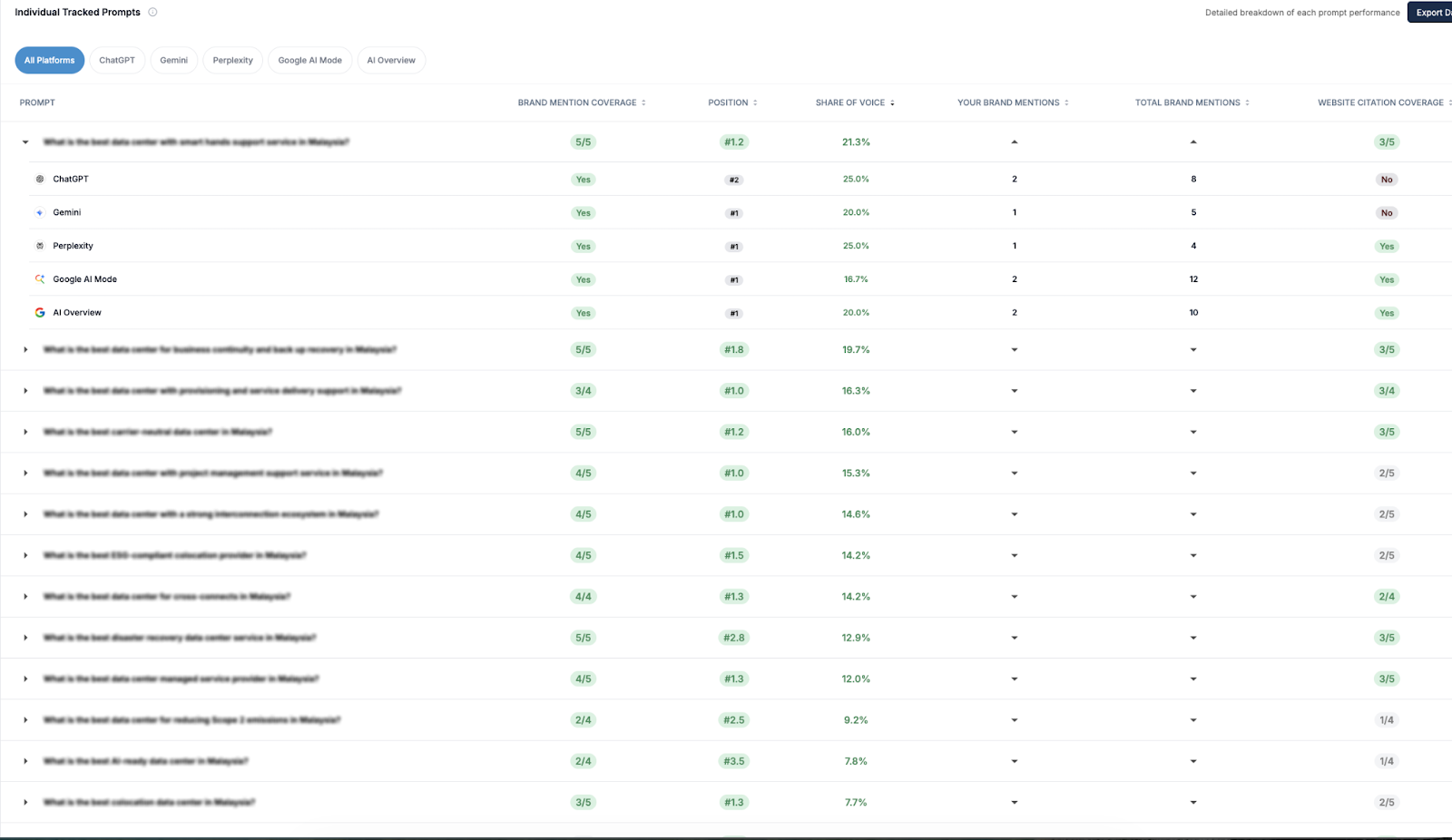
We mapped the prompt universe, our term for the 130 high-intent commercial and service-specific queries the brand’s buyers actually run on AI platforms. Tracked prompts were mapped against existing service pages. Structured answer sections on those pages were strengthened, and generic positioning was replaced with definitional clarity AI could extract cleanly.
Comparison-style queries were the priority content commissioning queue. That is where existing presence was inconsistent and where competitor density was rising.
-
AMPLIFICATION. Sustained presence.
This was the centre of gravity for the engagement. Weekly ranking-position tracking across all five named platforms. Prompts fluctuating outside top positions were prioritised for reinforcement. Content framing was adjusted to improve summarisation probability where AI was inconsistent in how it represented the brand. Competitor density per prompt was monitored, with reinforcement work scheduled wherever a competitor was gaining ground.
The compounding effect was unusual. Stability work on prompts the brand was already winning produced higher absolute ranking position over time, because consistency itself appears to be a signal AI weights.
The Numbers
By the end of the engagement, across 130 tracked prompts and five platforms:
- Brand mention coverage: 54.17% (78 out of 144 responses)
- Citation rate: 36.11% (52 out of 144 responses)
- Share of voice: 8.31%
- Average AI ranking position: 2.37 (consistently inside the top 3)
- Strong presence on “best provider” searches
- Higher share of voice on service-specific prompts
- Consistent multi-platform coverage across ChatGPT, Gemini, Perplexity, Google AI Overviews, and Google AI Mode
We measure outcomes against what we call the M-C-R stack: Mention, Citation, Recommendation. This engagement is the clearest example in the case library of working towards the Recommendation tier specifically. A 2.37 average ranking position is the leading indicator. Once a brand is consistently inside the top three on a query cluster, the work shifts towards becoming the suggested choice. Recommendation rate is the third tier and is now the active measurement programme for this client’s next quarter.
Three Observations
The Work Changes Once Presence Is Established
Most AI visibility programmes are about going from absent to present. The work after presence is established is different. Stability over headline growth. Ranking position over mention rate. Reinforcement over expansion. Programmes that keep optimising the same way after presence is established under-perform because they keep solving the previous problem.
Consistency Itself Appears to Be a Signal
On this engagement, prompts where the brand had been cited stably over time showed higher subsequent ranking positions than equivalently-cited prompts with volatile history. That is consistent with how AI evaluates editorial standing across the sources it reads. Stable citation patterns over time look like authority. Volatile patterns look like uncertainty.
Comparison Queries Are Where Existing Presence Gets Tested
“Best provider” queries and service-specific queries were strong on the baseline. Comparison queries were where presence was inconsistent. That is where buyers do their actual evaluation, and it is where the work has to compound. Programmes that report on aggregate mention rate without breaking out query type can miss this completely.
The work explicitly excluded several practices. This matters in 2026 because Google’s May 15 spam-policy update on generative search formally classified most of them as spam.
- No paid placements with passing links. Any sponsored editorial carried rel=”sponsored” or rel=”nofollow”.
- No syndicated press release distribution with optimised anchor text.
- No anonymous Wikipedia editing on the brand’s behalf.
- No AI-generated content published at scale.
- No incentivised or coordinated reviews on platforms AI reads.
These are not stylistic preferences. They are the line between sustainable AI visibility work and tactics that are about to be audited out of the market.
In May we renamed our signature practice from “AI Citation Engineering” to “AI Citation Enablement”. The acronym (AICE) stayed, the framing changed. “Engineering” implies working on AI’s evaluation. “Enablement” describes working on the brand. The second framing is the only one I am comfortable defending in client engagements over the next two years.
Where To Start
If your brand already has some AI presence and what you actually need is consistency and ranking-position stability, that is a different starting point. We run a complimentary AI Visibility Audit. It takes a week, surfaces ranking-position volatility across the major AI platforms, and identifies the prompts where existing presence is unstable. The audit is the diagnostic phase of the AI Visibility Operating System we build for enterprise CMOs.