An Education Brand Earned 529 Third-Party Citations Against 149 From Its Own Properties. The 3.5-to-1 Earned-to-Owned Ratio Is Why AI Citation Enablement Works.

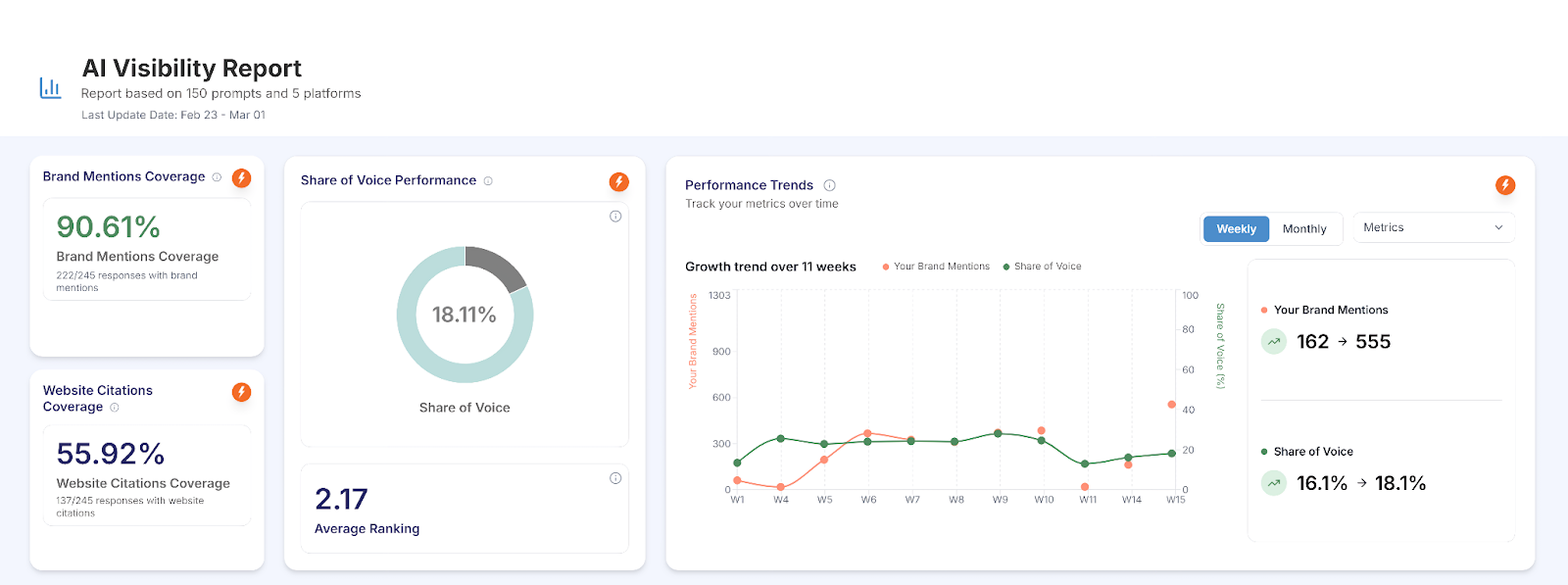
AI Visibility Report — overall results dashboard. 56.32% brand mention coverage, 51.05% citation rate, 12.47% share of voice, 2.98 average AI ranking.

What the PAVA Framework engagement involved across 38 high-intent student queries.

An education-sector client engaged us last quarter operating in a high-consideration buying journey. Prospective students were running queries like “best institutions for [program]” and “top colleges for [field]” on AI platforms before any open-day registration or admissions enquiry. The brand’s AI visibility was uneven across the five major platforms, and competitors with similar academic positioning were collecting the citations.

Ninety days later, the brand held 12.47% category share of voice against the four nearest competitors (8.2%, 3.3%, 3.2%, and lower), with 56.32% mention coverage and 51.05% citation rate across the 38 high-intent prompts the AI Visibility Audit identified.

Below is what the work involved, and what I would take from it.

The Starting Position

Education is a long-consideration purchase. The brand a prospective student names first in their applications shortlist often started forming six months earlier, in research conversations the institution never sees. AI platforms have absorbed a large share of those research conversations. The institution that appears repeatedly in answers to “best for X program” queries becomes the default reference.

That dynamic was already running around this client before we engaged. Their existing student recruitment programme was reporting healthy numbers on the channels they were measuring. The channel doing the early shortlisting work was unmeasured, and a smaller competitor with a sharper AI footprint was being named ahead of them in several priority queries.

We baselined the brand across ChatGPT, Gemini, Perplexity, Google AI Overviews, and Google AI Mode. We mapped 38 high-conversion-intent prompts that prospective students actually run. We benchmarked against the top four institutions in the category.

What the Work Involved

The engagement ran across all four pillars of the PAVA Framework: Presence, Authority, Visibility, Amplification. Each pillar addresses a question AI platforms appear to weigh before deciding whether to surface a brand in an answer.

  1. PRESENCE. Entity integrity.

We rebuilt the institution’s definitional statements so AI could categorise the brand accurately. Program-specific structured sections were deployed across the site for clean retrieval. FAQ blocks were architected for AI extractability rather than for ranking. Schema deployment covered organisation, educational organisation, course, and FAQ types. Canonical brand description aligned across LinkedIn, the relevant educational directories, and Wikipedia. Wikipedia work went through the standard contributor process with paid-contributor disclosure where the policy requires it.

  1. AUTHORITY. Earned editorial standing.

This is the dimension that produced the most striking result on the engagement. We mapped the third-party publications and rankings AI platforms actually cite in education-sector queries. Education-trade publications, ranking services, academic-credibility outlets. We briefed the brand’s existing communications partner against that target list with angle briefs aligned to genuine editorial opportunities.

The citation analysis at the end of 90 days told the story plainly: 529 earned-authority citations versus 149 owned-authority citations. AI was citing the brand from third-party sources roughly 3.5 times more often than from the brand’s own properties.

This is what AI Citation Enablement looks like on the earned side. AICE is the discipline we run across all four PAVA pillars: making the brand’s expertise easier for AI to find, verify, and accurately attribute, on the brand’s own merits. The earned-side weighting is not a Growth.pro opinion. It is what AI actually does.

  1. VISIBILITY. Content architecture.

We mapped the prompt universe, our term for the 38 high-conversion-intent queries that prospective students actually run on AI platforms. Comparison-style queries (“Institution A vs Institution B”) were prioritised because that is where shortlisting actually happens. Program-specific queries were optimised for inclusion inside multi-brand AI recommendations.

Owned content was restructured into the formats AI retrieval systems extract most reliably: direct answers at the top of program pages, comparison tables for evaluation-stage queries, named methodology frameworks for the institution’s pedagogical approach, and statistics sourced with publisher, sample, and year.

149 Owned Authority, 529 Earned Authority, 197 competitor citations monitored. Shows the earned-side weighting in AI category citation.
Citation analysis — 149 Owned Authority, 529 Earned Authority, 197 competitor citations monitored. Shows the earned-side weighting in AI category citation.
  1. AMPLIFICATION. Sustained presence.

The fourth line of work runs continuously. Mention coverage across the five named AI platforms was tracked weekly. Competitor density per prompt was monitored across the top-four competitive set, with reinforcement work scheduled wherever a competitor was gaining ground. Sentiment patterns across cited sources were watched.

AI-referred traffic was attributed all the way through to form submissions and WhatsApp enquiries via GA4, so AI visibility outcomes could be tied to actual prospective-student actions, not just mention volume.

The Numbers

AI VISIBILITY METRICS:

  • Brand mention coverage: 56.32%
  • Citation rate: 51.05%
  • Share of voice: 12.47% (nearest competitor: 8.2%)
  • Average AI ranking position: 2.98 (consistently inside the top 3)
  • Tracked prompts: 38 high-conversion-intent queries

CITATION ECOSYSTEM:

  • Owned-authority citations: 149
  • Earned-authority citations: 529
  • Competitor citations monitored: 197
  • Earned-to-owned ratio: 3.5-to-1

AI-DRIVEN TRAFFIC (Dec 19 – Mar 18):

  • AI sessions: 218
  • Engaged sessions: 109
  • Engagement rate: 50%
  • Attribution down to: form submissions, WhatsApp enquiries, multi-session engagement
Competitive AI Performance — share of voice and citation volume against four tracked competitors.
Individual tracked prompts — coverage across the 38-prompt priority set.
AI-driven sessions and engagements across the engagement window.

We measure outcomes against what we call the M-C-R stack: Mention, Citation, Recommendation. This engagement moved the first two materially. The 2.98 average ranking position puts the brand on the doorstep of the Recommendation tier across most tracked queries. Recommendation rate, where the brand is the suggested choice in a commercial-intent answer, is the third tier and the next horizon for the measurement programme.

The number worth holding on to from this engagement is the 3.5-to-1 earned-to-owned citation ratio. AI did not weight the brand’s own website equally against the third-party sources. It weighted the third-party sources nearly four times more heavily. That dynamic is the structural reason marketing programmes that focus exclusively on owned content under-perform in AI search.

Three Observations

In Education, the Comparison Query Is the Battlefield.

A prospective student running “Institution A vs Institution B” is in active shortlist mode. The institutions named in those answers get into the shortlist. The ones absent do not. We deliberately prioritised comparison-style queries during the content work. Programmes that optimise only for branded queries miss the layer where shortlisting actually happens.

Earned Citations Outweigh Owned Citations by Roughly 4 to 1 in AI Citation Decisions.

This case put a number on the asymmetry. 529 earned versus 149 owned. The implication for marketing budget allocation is direct: under-investment in editorial standing in the publications and ranking services AI reads is the most common reason brands under-perform their owned-content investment in AI search. We pushed the client’s communications partner against the citation-source map. The 529 earned citations are what that work produced.

Education Has Harder-to-Fool AI Buyers Than Almost Any Other Category

The buyer is making a four-year decision. They cross-reference multiple AI platforms, read the cited sources, check rankings independently. Brands that try to engineer citations through low-quality content or recommendation poisoning get filtered out of the consideration set early. The disciplined approach is the only approach that works here.

What Was Not in Scope

The work explicitly excluded several practices. This matters in 2026 because Google’s May 15 spam-policy update on generative search formally classified most of them as spam.

  • No paid placements with passing links. Any sponsored editorial carried rel=”sponsored” or rel=”nofollow”.
  • No syndicated press release distribution with optimised anchor text.
  • No anonymous Wikipedia editing on the brand’s behalf.
  • No AI-generated content published at scale.
  • No incentivised or coordinated reviews on platforms AI reads.

These are not stylistic preferences. They are the line between sustainable AI visibility work and tactics that are about to be audited out of the market.

In May we renamed our signature practice from “AI Citation Engineering” to “AI Citation Enablement”. The acronym (AICE) stayed, the framing changed. “Engineering” implies working on AI’s evaluation. “Enablement” describes working on the brand. The second framing is the only one I am comfortable defending in client engagements over the next two years.

Where to Start

If your institution has not been benchmarked against the major AI platforms, that is the place to start. We run a complimentary AI Visibility Audit. It takes a week and produces a board-ready benchmark against your top competitors across all five major AI platforms, with citation-ecosystem analysis splitting owned from earned. The audit is the diagnostic phase of the AI Visibility Operating System we build for institutions running long-consideration buyer journeys.

DM me if that is useful.

Share the Post:

Related Posts