What The PAVA Framework Engagement Looks Like In A Long-cycle B2B Services Category Starting From Absent.
An architectural services client engaged us in December 2024 in a clean baseline position. Zero AI citations. The brand had a respectable web presence and was performing reasonably on Google for branded queries. Inside ChatGPT, Gemini, Perplexity, Google AI Overviews, and Copilot, the brand was completely absent from category-relevant answers.
By August 2025, eight months into the engagement, the brand held 99 AI citations across the five platforms, with year-on-year AI traffic growth of 12,800% and year-on-year AI events growth of 21,800%. The brand had moved from “not in the AI conversation” to “consistently named in category answers.” From a small base, but the trajectory and the structural shift are the read.
Below is what the work involved, and what I would take from it.
The Starting Position
Architectural services is a long-cycle B2B services category. A buyer makes the engagement decision over months, often with multiple stakeholders, and the early consideration set is shaped well before any direct outreach. AI platforms have moved into that early consideration window. The brand named in “best architecture firms for [project type]” answers, or “alternatives to [established firm name]” answers, gets considered. The brands absent do not.
This client was absent. Not under-performing. Absent.
We baselined the brand across ChatGPT, Gemini, Perplexity, Google AI Overviews, and Copilot. We mapped category-relevant questions buyers would actually ask. The picture was the cleanest possible starting position: zero citations, no presence to defend, full ability to architect the work from scratch.
What The Work Involved
The engagement ran across all four pillars of the PAVA Framework: Presence, Authority, Visibility, Amplification. Each pillar addresses a question AI platforms appear to weigh before deciding whether to surface a brand in an answer.
-
PRESENCE. Entity integrity.
We mapped the brand’s content topics against Google’s Knowledge Graph entities so AI could place the brand inside the right category and project-type taxonomy. Brand mention consistency was aligned with AI Overview inclusion criteria across the brand’s own site, LinkedIn, Crunchbase, and the relevant industry directories. Internal linking structures were rebuilt to clarify entity relationships across the site. Schema deployment covered organisation, FAQ, How-To, and Author types. Canonical brand description aligned across all external channels. Wikipedia work went through the standard contributor process with paid-contributor disclosure where the policy requires it. -
AUTHORITY. Earned editorial standing.
We mapped the third-party publications and category sources AI cites in architectural services. Trade publications, project-type-specific outlets, regional architecture media. We briefed the brand’s existing communications partner against that target list with angle briefs the firm could pursue on the merits of the work. Citation outcomes measured against each placement.This is what AI Citation Enablement looks like on the earned side. AICE is the discipline we run across all four PAVA pillars: making the brand’s expertise easier for AI to find, verify, and accurately attribute, on the brand’s own merits.
-
VISIBILITY. Content architecture.
We mapped the prompt universe, our term for the high-intent advisory and category questions architectural services buyers actually run on AI platforms. The brand’s content was expanded into long-form Q&A formats specifically structured for snippet extraction. FAQ, How-To, and Author schemas were deployed at scale across the relevant pages. Direct answers led the section openings. Comparison logic was built into the project-type pages.The structural design philosophy: every page should be cleanly extractable by AI as either a complete answer to a category question, a comparison reference, or an entity definition. No filler content.

-
AMPLIFICATION. Sustained presence.
Continuous monitoring across all five AI platforms covered in this engagement. Iterative testing of the visibility triggers on each platform, since the citation patterns differ meaningfully across ChatGPT, Gemini, Perplexity, AI Overviews, and Copilot. A custom analytics dashboard was built to separate AI-generated answer referrals from AI-driven search traffic, with the citations → sessions → conversions pipeline tracked end-to-end.
The Numbers
CITATION GROWTH (Dec 2024 → Aug 2025):
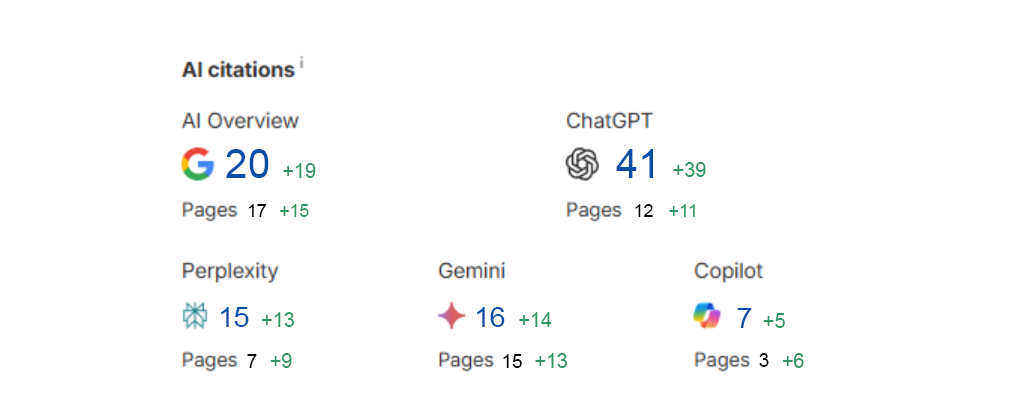
- AI citations: 0 → 99 across five platforms
- ChatGPT: 41 citations on 12 pages (+39 vs baseline)
- Google AI Overview: 20 citations on 17 pages (+19)
- Gemini: 16 citations on 15 pages (+14)
- Perplexity: 15 citations on 7 pages (+13)
- Copilot: 7 citations on 3 pages (+5)
AI TRAFFIC PERFORMANCE:
- AI-sourced users: 278
- New AI users: 235
- Year-on-year AI traffic growth: +12,800%
- Year-on-year AI events growth: +21,800%
- Key events from AI users: 29
QUERY-TYPE SHIFT:
- Branded queries: steady growth
- Non-branded queries: surged, confirming category-level discovery via AI
We measure outcomes against what we call the M-C-R stack: Mention, Citation, Recommendation. This engagement moved the first two from zero to material across the five platforms. The 29 key events from AI users are the early pipeline signal. Recommendation rate, where the brand is the suggested choice in a commercial-intent answer, is the third tier and the next horizon for the measurement programme.
The structural finding is the non-branded query surge. Branded queries grew steadily, which is what you would expect from improved owned-channel work. Non-branded queries surged disproportionately, which means AI was independently surfacing the brand on category questions where the buyer did not yet know the brand existed. That is the structural shift. From not in the conversation to part of the answer.
Three Observations
Zero Is A Useful Starting Baseline.
Most AI visibility engagements are messy because they inherit partial presence, inconsistent positioning, and historical content debt. Starting from zero AI citations is structurally cleaner. The team can architect the entire content and entity model around AI extractability from the start, with no legacy to work around. Most engagements have a version of this opportunity if they are willing to rebuild rather than retrofit.
The Platform Split Tells You Where To Double Down.
ChatGPT produced 41 of the 99 citations on 12 pages. That is roughly 3.4 citations per cited page. Perplexity produced 15 citations on 7 pages, roughly 2.1 per cited page. Different platforms reward different content structures. Pages that earn citations on multiple platforms are the highest-leverage assets in the content library. Tracking citation-per-page across platforms is a more useful diagnostic than tracking citations alone.
Non-branded Query Growth Is The Structural Signal.
Branded query growth is owned-channel work. Non-branded query surge is category-level AI discovery. The first is recoverable through SEO refresh. The second is durable only through sustained AICE work, because it requires the brand to be in the AI’s answer when the buyer does not yet know to ask for the brand by name. That distinction matters for how AI visibility outcomes get reported.
What Was Not In Scope
The work explicitly excluded several practices. This matters in 2026 because Google’s May 15 spam-policy update on generative search formally classified most of them as spam.
- No paid placements with passing links. Any sponsored editorial carried rel=”sponsored” or rel=”nofollow”.
- No syndicated press release distribution with optimised anchor text.
- No anonymous Wikipedia editing on the brand’s behalf.
- No AI-generated content published at scale.
- No incentivised or coordinated reviews on platforms AI reads.
These are not stylistic preferences. They are the line between sustainable AI visibility work and tactics that are about to be audited out of the market.
In May we renamed our signature practice from “AI Citation Engineering” to “AI Citation Enablement”. The acronym (AICE) stayed, the framing changed. “Engineering” implies working on AI’s evaluation. “Enablement” describes working on the brand. The second framing is the only one I am comfortable defending in client engagements over the next two years.
Where To Start
If your brand has near-zero AI presence and you are wondering whether the work is worth doing, this case is the clearest evidence of how the work compounds from a clean baseline. We run a complimentary AI Visibility Audit. It takes a week and produces a board-ready benchmark across all five major AI platforms, including a zero-baseline read where applicable. The audit is the diagnostic phase of the AI Visibility Operating System we build for enterprise CMOs.
DM me if that is useful.