What The Foundational Layer Of A PAVA Engagement Looks Like, And Why Content Restructure Produces Compounding Lift On Both AI Visibility And Traditional Search.
An eCommerce client engaged us with a familiar problem and an unusual willingness to question their own assumption about the solution. Traffic was plateauing. The default response would have been to publish more content. We made a different recommendation. Restructure the pages already on the site so AI extraction and Google’s traditional ranking signals could both read them clearly. No new pages. No content velocity push.
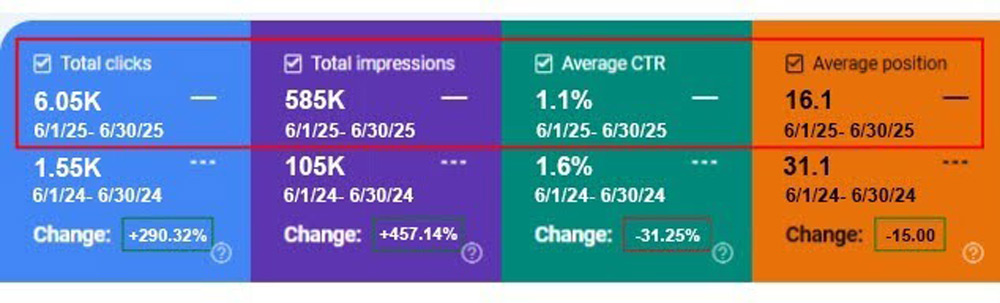
Year over year, monthly clicks moved from 1.55K to 6.05K, a 290.32% lift. Monthly impressions moved from 105K to 585K, a 457.14% lift. Average search position improved 15 spots, from 31.1 to 16.1.
Below is what the work involved, and what I would take from it.
The Starting Position
Most eCommerce brands respond to traffic plateaus by adding content. More blog posts, more category descriptions, more category-landing pages. The instinct is reasonable. The execution rarely produces compounding lift because the content debt added to the site usually outweighs the visibility gain from any individual new page.
This client had years of existing content that was structurally invisible to both AI extraction systems and modern Google ranking. The pages were not bad. They were not optimised for the shape of content AI surfaces and Google’s modern systems reward. Fixing the existing pages produced more lift than any new content would have.
This is the foundational PAVA work. Before earned editorial standing matters, before continuous source-ecosystem monitoring matters, the brand has to be cleanly readable by AI and by modern search. That readability is on-page work.
What The Work Involved
This engagement was scoped to the foundational layer of the PAVA Framework — primarily Presence and Visibility pillars. Authority work and Amplification were not in this engagement’s scope.
-
PRESENCE. Entity integrity.
Structured metadata and NLP-driven entity optimisation were embedded across the relevant pages, so search systems could associate the brand cleanly with topical authority in its product niches. Internal linking structures were rebuilt to connect product pages, parent categories, and supporting content into a coherent topical web. The site’s entity model was tightened before any other intervention. -
VISIBILITY. Content architecture.
This is where the compounding lift came from. Intent-led keyword clustering, our equivalent of prompt-universe mapping, surfaced the existing pages with untapped commercial potential. Those pages were enriched with FAQ blocks tuned for the actual buyer questions, short trust-building snippets, and contextual detail that improved semantic depth. The content shape moved from generic category copy to AI-extractable answer structure.A 30-day continuous optimisation loop was operationalised, with weekly performance tracking informing micro-adjustments to the priority pages.
The deliberate exclusion: no content velocity. Not a single new page was commissioned for the SEO metric lift this case is showing. Every gain came from restructuring what was already there.
The Numbers
YEAR-OVER-YEAR PERFORMANCE (June 2025 vs June 2024):
- Monthly clicks: 1.55K → 6.05K (+290.32%)
- Monthly impressions: 105K → 585K (+457.14%)
- Average search position: 31.1 → 16.1 (improvement of 15 spots)
DELIBERATE EXCLUSIONS:
- No new content published
- No content velocity push
- Every gain attributable to restructuring existing pages
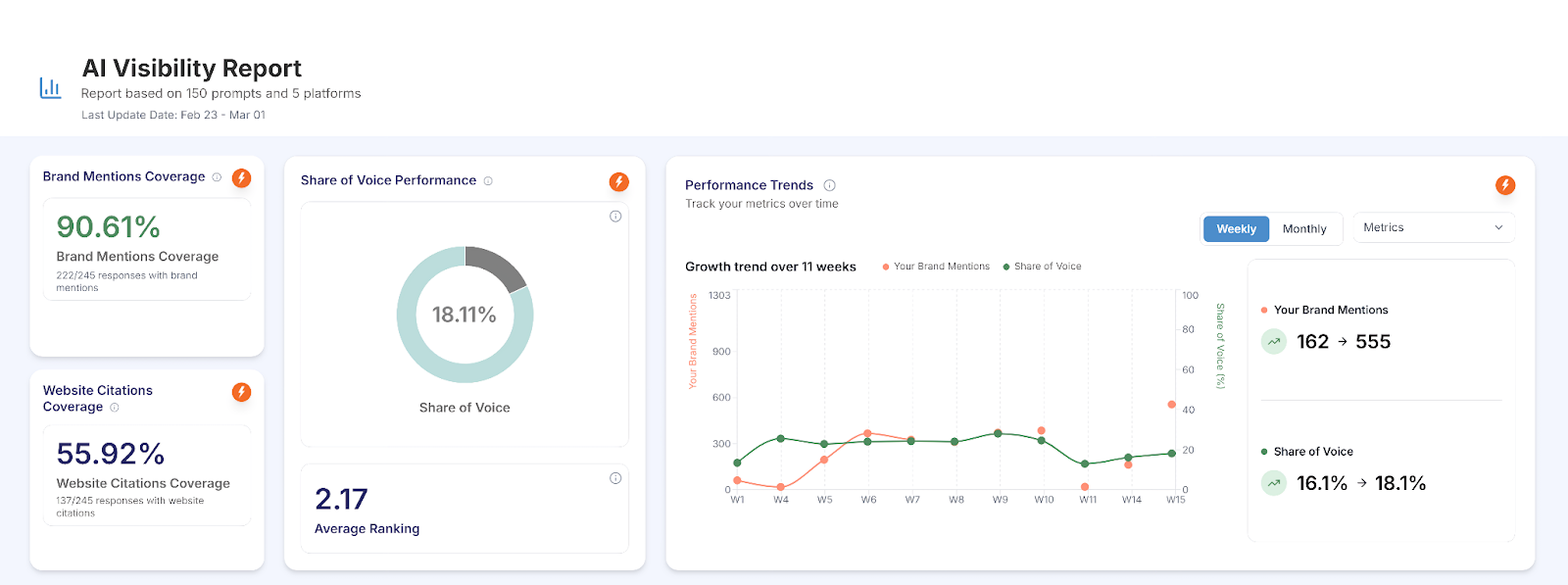
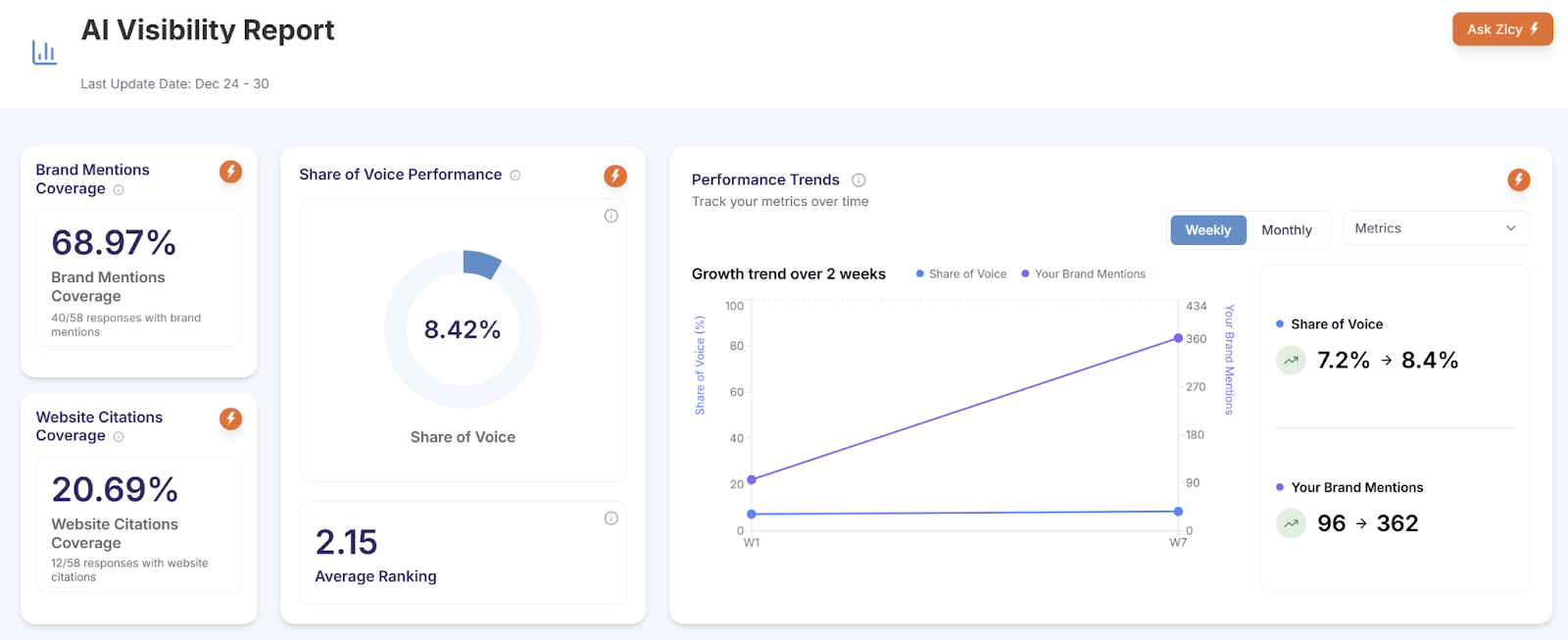
We measure AI visibility outcomes against what we call the M-C-R stack: Mention, Citation, Recommendation. The lift in this case is on traditional search metrics, not directly on AI mention coverage. That is not a weakness of the case. It is the structural point.
Google’s AI Overviews and AI Mode use the same content-clarity signals AI retrieval systems use for citation. Content restructured for clean AI extraction produces compounding lift on Google’s traditional ranking surfaces and on Google’s AI surfaces simultaneously. The 290% clicks lift on traditional search is the visible proof that the underlying content-clarity work is being read by Google’s modern systems. The full AI mention and citation programme builds on this foundation.
For brands evaluating where to start, this case is the strongest evidence that the foundational PAVA work pays for itself on metrics the CMO is already measuring.
Three Observations
Publishing Velocity Is The Most Over-prescribed Prescription In Content Marketing.
The instinct to “publish more” persists because it produces visible activity. Activity is not the same as visibility. Restructuring existing pages produced a 290% clicks lift in this case. Publishing more pages over the same window would have produced a fraction of that, with significant ongoing content debt. Most eCommerce brands have years of underperforming pages that compound when fixed.
Content Clarity Is Where Traditional SEO And AI Visibility Converge.
The pages that win in AI extraction also win in modern Google ranking. Both systems reward direct answers at the top of sections, clear entity signals, comparison-logic framing, and statistics sourced with publisher, sample, and year. The skills set for traditional SEO and the skills set for AI extraction overlap more than the field acknowledges. The brand that does this work well wins both surfaces.
The 30-day Optimisation Loop Is Where The Lift Actually Compounds.
The headline numbers came from the restructure. The compounding came from the loop. Each 30-day cycle informed micro-adjustments on the priority pages, validated by weekly tracking. Most content programmes do the initial work and then stop. The discipline of the optimisation loop is what produced the +15 average position improvement over the full window.
What Was Not In Scope
This engagement was scoped to foundational Presence and Visibility work. The earned-side Authority work and the continuous Amplification monitoring across the five AI platforms were not in this engagement’s scope. That work is the layer that compounds on top of foundational content clarity, and it is where the structural moat over policy-line-crossing competitors gets built.
The work explicitly excluded several practices, as it does across every Growth.pro engagement. This matters in 2026 because Google’s May 15 spam-policy update on generative search formally classified most of them as spam.
- No paid placements with passing links. Any sponsored editorial carried rel=”sponsored” or rel=”nofollow”.
- No syndicated press release distribution with optimised anchor text.
- No AI-generated content published at scale.
- No keyword stuffing, doorway pages, or scaled low-quality content.
- No incentivised or coordinated reviews on platforms AI reads.
In May we renamed our signature practice from “AI Citation Engineering” to “AI Citation Enablement”. The acronym (AICE) stayed, the framing changed. “Engineering” implies working on AI’s evaluation. “Enablement” describes working on the brand. The second framing is the only one I am comfortable defending in client engagements over the next two years.
Where To Start
If your brand is sitting on years of existing content that is not producing the search and AI visibility outcomes it should, the restructure is almost always the right starting point, before any new content commissioning. We run a complimentary AI Visibility Audit that includes a foundational-pages diagnostic, identifying which existing pages have the most upside from restructuring. The audit is the diagnostic phase of the AI Visibility Operating System we build for consumer brands.
DM me if that is useful.