What The PAVA Framework Engagement Looks Like When Conversion Attribution From AI Traffic is The Primary Outcome.
A services client engaged us with a specific brief. They were watching AI search adoption climb in their category and wanted to know two things. First, could AI platforms produce real, attributable users to their site. Second, would those users convert.
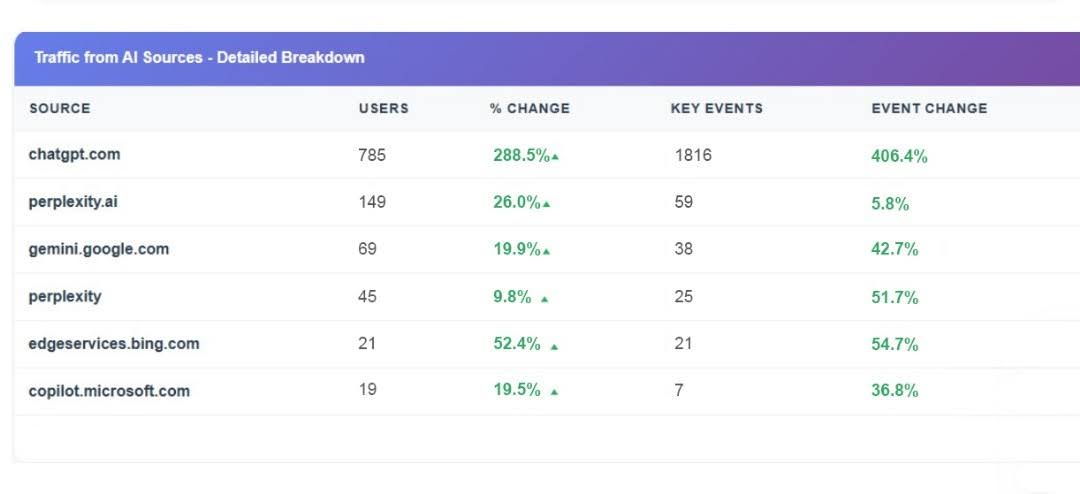
Across the seven-month engagement (January to July 2025), the brand pulled in 1,088 users from AI platforms and 1,966 tracked conversion events. ChatGPT event growth alone was 406.4%. Event growth across the smaller platforms ranged from 36.8% to 54.7%.
Below is what the work involved, and what I would take from it.
The Starting Position
Most CMOs treating AI search as experimental have one underlying question. Does AI traffic actually convert, or is it tyre-kicking? The intuition that AI users might be in higher-funnel research mode is reasonable. The data is now consistent that AI users are increasingly bottom-funnel, qualified buyers who have done the comparison work in the chat window.
This client wanted to verify that in their category. We baselined them across ChatGPT, Gemini, Perplexity, AI Overviews, AI Mode, Edge (Bing AI), and Copilot, with full GA4 event attribution stitched in. The brand had partial AI presence to start with. The work was about doubling down on content structure for AI extraction and rebuilding the technical layer so AI crawlers could access and parse the priority pages cleanly.
The seven-month read produced a conversion picture, not just a traffic picture.
What The Work Involved
The engagement ran across all four pillars of the PAVA Framework: Presence, Authority, Visibility, Amplification. Each pillar addresses a question AI platforms appear to weigh before deciding whether to surface a brand in an answer.
-
PRESENCE. Entity integrity and technical infrastructure.
Schema markup was rolled out across product and service pages. Header hierarchies (H1 through H6) were fixed for logical flow that AI parsers could follow. Image alt text was rewritten for clarity rather than keyword stuffing. The robots.txt file was updated to give AI crawlers full access to the priority pages. Canonical brand description aligned across LinkedIn, Crunchbase, and the relevant directories. Wikipedia work went through the standard contributor process with paid-contributor disclosure where the policy requires it.
-
AUTHORITY. Earned editorial standing.
We mapped the third-party publications and category outlets AI cites in this services category, then briefed the brand’s existing PR partner against the target list with angle briefs the firm could pursue on the merits of the work. Citation outcomes measured against each placement.
This is what AI Citation Enablement looks like on the earned side. AICE is the discipline we run across all four PAVA pillars: making the brand’s expertise easier for AI to find, verify, and accurately attribute, on the brand’s own merits.
-
VISIBILITY. Content architecture.
The research model was rebuilt from the ground up. Instead of starting with keywords, the team mapped customer pain points and USP-led messaging onto topic clusters built around high-intent themes. Competitor mentions inside AI responses were analysed, not just competitor SERP positions. Bottom-funnel content was the priority commissioning queue, not vanity-traffic pages.
Content structure was rebuilt for AI extraction. Concise takeaway sections were added at the top of every page for snippet-style answers. Content was restructured into an answer-first inverted pyramid. FAQ blocks were deployed against the actual buyer questions surfaced in the research phase.
-
AMPLIFICATION. Sustained presence and measurement.
Continuous monitoring across all the platforms covered in the engagement. Tracking systems were built to isolate AI-originating traffic in GA4. Behavioural analysis mapped AI-driven conversion journeys so the insights from the bottom-funnel pages could feed back into new commissioning. The measurement layer was the centre of gravity for this engagement specifically because conversion attribution was the brief.
The Numbers
AI-REFERRED USERS (Jan – July 2025):
- ChatGPT: 785 users (+288.5%)
- Perplexity.ai: 149 users (+26.0%)
- Gemini (Google): 69 users (+19.9%)
- Perplexity: 45 users (+9.8%)
- Edge (Bing AI): 21 users (+52.4%)
- Copilot (Microsoft): 19 users (+19.5%)
- Total AI-referred users: 1,088
CONVERSION EVENTS:
- Total tracked key events: 1,966
- ChatGPT event growth: +406.4%
- Gemini event growth: +42.7%
- Perplexity event growth: +51.7%
- Edge event growth: +54.7%
- Copilot event growth: +36.8%
We measure outcomes against what we call the M-C-R stack: Mention, Citation, Recommendation. This engagement is the clearest evidence in the case library that AI-referred traffic converts at qualified-buyer rates. The 1,966 tracked events from 1,088 users is a ratio that does not happen with tyre-kicker traffic. Recommendation rate, where the brand is the suggested choice in a commercial-intent answer, is the third tier and the next horizon for the measurement programme.
The ChatGPT 406% event growth is the headline number. The more useful read is the platform spread. Every platform measured produced material event growth. AI traffic is not a ChatGPT-only conversion channel. It is a multi-platform conversion channel where ChatGPT happens to currently produce the largest absolute volume.
Three Observations
The Events-to-users Ratio Is The Buyer-intent Read.
1,966 events from 1,088 users means each AI-referred user produced roughly 1.8 tracked events on average. That is the behavioural fingerprint of qualified, bottom-funnel buyer traffic. Tyre-kicker traffic typically produces less than one tracked event per user. The ratio is the diagnostic.
The Platform Split Does Not Predict The Event Growth Ordering.
Edge produced 21 AI-referred users in absolute terms, less than 2% of the total. Edge event growth, however, was 54.7%, higher than Gemini and Copilot. Different platforms attract different visitor profiles. Smaller-volume platforms can produce higher-velocity event growth precisely because the visitors arriving from them are more highly qualified. CMOs evaluating channel investment based on traffic volume alone systematically under-invest in the smaller platforms that punch above their weight.
The Robots.txt Update Is The Lowest-cost Intervention With Measurable Lift.
Most websites have robots.txt configurations written years ago for traditional search engines. AI crawlers are not in those configurations. On many engagements, simply updating robots.txt to give AI crawlers explicit access to the priority pages produces a measurable lift in citation and traffic outcomes within weeks, with no content or PR investment. It is the easiest intervention in the playbook. Most sites have not done it.
What Was Not In Scope
The work explicitly excluded several practices. This matters in 2026 because Google’s May 15 spam-policy update on generative search formally classified most of them as spam.
- No paid placements with passing links. Any sponsored editorial carried rel=”sponsored” or rel=”nofollow”.
- No syndicated press release distribution with optimised anchor text.
- No anonymous Wikipedia editing on the brand’s behalf.
- No AI-generated content published at scale.
- No incentivised or coordinated reviews on platforms AI reads.
These are not stylistic preferences. They are the line between sustainable AI visibility work and tactics that are about to be audited out of the market.
In May we renamed our signature practice from “AI Citation Engineering” to “AI Citation Enablement”. The acronym (AICE) stayed, the framing changed. “Engineering” implies working on AI’s evaluation. “Enablement” describes working on the brand. The second framing is the only one I am comfortable defending in client engagements over the next two years.
Where To Start
If your brand is treating AI search as experimental and wants conversion attribution data before scaling investment, that is the right place to start. We run a complimentary AI Visibility Audit that includes a conversion-attribution readiness diagnostic. It takes a week, surfaces whether your existing GA4 setup can attribute AI traffic cleanly, and produces a board-ready benchmark across the major AI platforms. The audit is the diagnostic phase of the AI Visibility Operating System we build for enterprise CMOs.
DM me if that is useful.