What The PAVA Framework Engagement Looks Like at Scale, and The Textbook Example of AI Citation Enablement in Practice.
An eCommerce client engaged us with the same hypothesis I have heard from a dozen CMOs in the last six months. Product discovery was moving from Google to ChatGPT in their category. Their buyers were asking conversational platforms “which is the best product for X?” or “what is a good alternative to Y?” before any traditional search. The brand had partial citation presence but no systematic visibility programme.
Across four months, AI citations grew from 70 to 531 across the five platforms we measured. ChatGPT share of voice reached 53.6%, more than double the nearest competitor at 24.2%. The brand became the AI answer in its category.
Below is what the work involved, and what I would take from it.
The Starting Position
In product-led eCommerce categories, the buyer’s decision often crystallises inside the chat window. Three or four brands get named. The buyer narrows from there. The brand that gets named most consistently across multiple AI platforms becomes the perceived category leader, regardless of which brand is technically the largest by revenue or the strongest on Google.
This client wanted to be that brand. They had the product depth to be it. They did not yet have the AI citation footprint.
We baselined the brand across ChatGPT, Gemini, Perplexity, Google AI Overviews, and Copilot. The starting position was 70 citations across these platforms. We mapped the high-intent product-discovery and comparison queries that buyers in this category actually run. We benchmarked against the named competitors in the AI consideration set.
What The Work Involved
The engagement ran across all four pillars of the PAVA Framework: Presence, Authority, Visibility, Amplification. Each pillar addresses a question AI platforms appear to weigh before deciding whether to surface a brand in an answer.
This case is the textbook example of AI Citation Enablement in practice. AICE is the discipline we run across all four PAVA pillars: making the brand’s expertise easier for AI to find, verify, and accurately attribute, on the brand’s own merits. We work on the brand side of the equation. We do not work against the AI’s evaluation. This case shows what that work compounds to over a four-month window.
-
PRESENCE. Entity integrity.
Brand anchors were structured using entity-based schema markup across the catalogue. Product pages were upgraded with detailed image alt text and visual schema, because AI retrieval is increasingly multimodal and a product description without machine-readable image context surrenders citation eligibility on visual-led queries. Schema deployment covered organisation, product, offer, and review types. Canonical brand description aligned across LinkedIn, Crunchbase, and the relevant retail directories. Wikipedia work went through the standard contributor process with paid-contributor disclosure where the policy requires it.
-
AUTHORITY. Earned editorial standing.
We mapped the third-party publications and category review outlets AI cites in this product category. We briefed the brand’s existing PR and partnership team against that target list with angle briefs the firm could pursue on the merits of the work. Citation outcomes measured against each placement, with the citation-source map informing where to double down for the next quarter.
-
VISIBILITY. Content architecture.
This pillar carried the most weight on this engagement. Content was rebuilt around intent rather than keywords. Sections answering “which is best for…”, “should I choose…”, and “difference between…” were architected into product and category pages, structured for clean extraction. Long-tail semantic triggers were embedded throughout. Layered FAQ schemas were deployed where the FAQ content was genuine, not invented. Headers were crafted for contextual clarity that AI parsers could follow.
The multimodal upgrade was the differentiator. Infographics and short-form video were added to support AI’s multimodal outputs. As AI retrieval systems mature toward integrating image and video signals, brands that invested in multimodal AI-readability early hold a durable lead.
-
AMPLIFICATION. Sustained presence.
Continuous monitoring across all five named AI platforms. Referrer tracking via chat.openai.com, Perplexity, and Gemini origin traffic flagged in GA4. Citation outcomes tracked per page so the content commissioning queue could be refined against actual extraction patterns. Competitor density monitored per query cluster.
The Numbers
AI CITATIONS (4-month engagement):
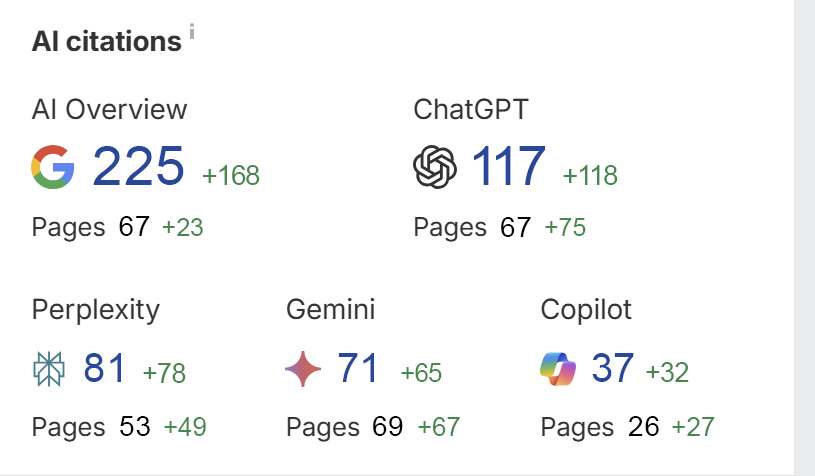
- Google AI Overview: 225 citations (+168 vs baseline) across 67 pages
- ChatGPT: 117 citations (+118 vs baseline) across 67 pages
- Perplexity: 81 citations (+78 vs baseline) across 53 pages
- Gemini: 71 citations (+65 vs baseline) across 69 pages
- Copilot: 37 citations (+32 vs baseline) across 27 pages
- Total citations: 531 (from 70 baseline)
- Citation growth: +461 across the four-month window
CHATGPT SHARE OF VOICE:
- Brand share of voice: 53.6%
- Nearest competitor: 24.2%
- Brand SOV more than 2.2 times the nearest competitor
We measure outcomes against what we call the M-C-R stack: Mention, Citation, Recommendation. This engagement is the strongest Citation-tier result in the case library at 531 total citations. The 53.6% ChatGPT share of voice puts the brand in Recommendation tier territory specifically on that platform. The brand is now the suggested choice in a material share of commercial-intent ChatGPT answers in the category.
The structural finding is the citation-density-per-page ratio. ChatGPT produced 117 citations across 67 pages, which is 1.75 citations per cited page. Google AI Overview produced 225 citations across 67 pages, which is 3.36 citations per cited page. Different platforms cite the same page set at very different densities. The page set that AI Overview is heavily reusing is the highest-leverage content asset library in the engagement. Page-level citation density is the diagnostic that tells you which pages to reinforce and which to leave alone.
Three Observations
This Is What The Aice Rebrand Actually Looks Like.
We renamed our signature practice from “AI Citation Engineering” to “AI Citation Enablement” in May 2026. This case is the clearest evidence of why the language change matters. Nothing on this engagement worked on AI’s evaluation process. Everything worked on the brand’s own assets: clearer entity definition, cleaner extraction structure, better multimodal readability, more accurate content alignment with the buyer’s actual questions. The 531 citations are the brand’s expertise being found, verified, and accurately attributed at scale. AI did the citation work. We made the brand’s expertise easier to cite.
Multimodal Readability Is The Next Investment Frontier.
The current AI retrieval models are increasingly multimodal. Brands that invested in image alt text quality, visual schema, infographics structured for AI consumption, and short-form video transcripts in 2025 and 2026 are holding citation leads that brands relying on text-only optimisation cannot easily close. This case is the early demonstration. Most brands have not done this work.
Page-level Citation Density Is The Leading-indicator Diagnostic.
Citation count tells you visibility scale. Citation count per cited page tells you which pages are doing the heavy lifting. The pages cited at high density across multiple platforms are the highest-leverage assets in the content library, and those are the pages to reinforce and replicate from. Most AI visibility programmes track totals only. The page-level diagnostic is where the next quarter’s commissioning queue should come from.
What Was Not In Scope
The work explicitly excluded several practices. This matters in 2026 because Google’s May 15 spam-policy update on generative search formally classified most of them as spam.
- No paid placements with passing links. Any sponsored editorial carried rel”sponsored” or rel”nofollow”.
- No syndicated press release distribution with optimised anchor text.
- No anonymous Wikipedia editing on the brand’s behalf.
- No AI-generated content published at scale.
- No incentivised or coordinated reviews on platforms AI reads.
These are not stylistic preferences. They are the line between sustainable AI visibility work and tactics that are about to be audited out of the market.
The “Engineering” framing for this practice carried adjacency to manipulation tactics that the May 2026 policy update classifies as spam. The “Enablement” framing describes the work accurately. Reverting to engineering language in client conversations quietly reintroduces the policy-line risk the rebrand was designed to step away from. The acronym (AICE) carries across. The framing does not.
Where To Start
If your eCommerce brand has partial AI citation presence and you are evaluating what a 90-to-120-day acceleration could look like, this case is the clearest evidence of the achievable trajectory. We run a complimentary AI Visibility Audit that includes a citation-density diagnostic and a multimodal readiness assessment. It takes a week and produces a board-ready benchmark across all five major AI platforms. The audit is the diagnostic phase of the AI Visibility Operating System we build for consumer brands.