What The PAVA Framework Engagement Looks Like When AI Cites The Commercial Page, Not The Blog.
A US-based eCommerce client engaged us last quarter selling contact lenses online. The category is comparison-heavy. Buyers run “best [brand] for [use case]” queries inside AI platforms before they buy. The brand wanted to understand which competitors AI was preferring and what it would take to flip the answer.
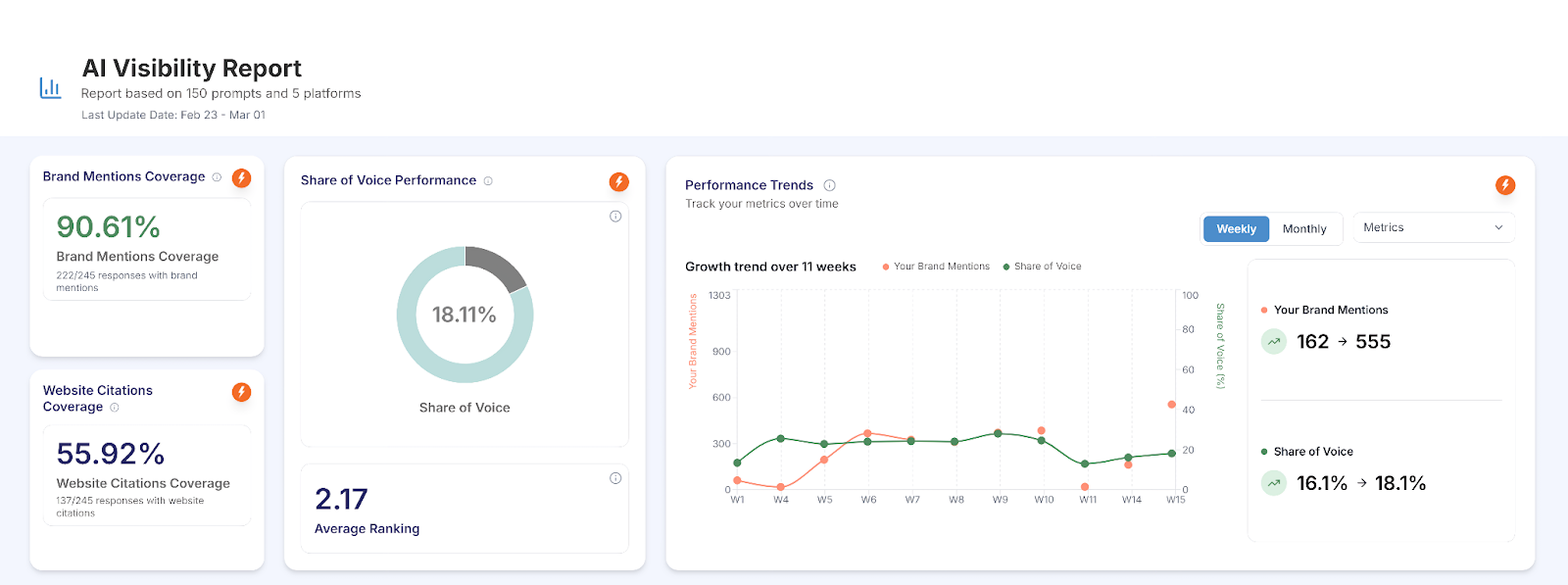
Across the engagement, AEO traffic grew 1,207% while total site traffic grew 21%. The brand took the #1 share-of-voice position in its category at 18.11%. AI-referred users were landing on commercial product URLs with 89% to 94% engagement rates. The product pages were the cited pages.
Below is what the work involved, and what I would take from it.
The Starting Position
Contact lenses are a near-perfect category for AI-led product discovery. The buyer knows the brand, knows the prescription, and is in active comparison mode on price, packaging, delivery speed, and trust signals. Running that comparison inside an AI platform takes 30 seconds. Running it across multiple eCommerce sites takes 30 minutes. AI wins this kind of comparison decisively.
That dynamic was already running around this client. Their traditional commerce funnel was healthy. SEO was performing. The question was whether they were even in the AI shortlist when buyers ran category queries.
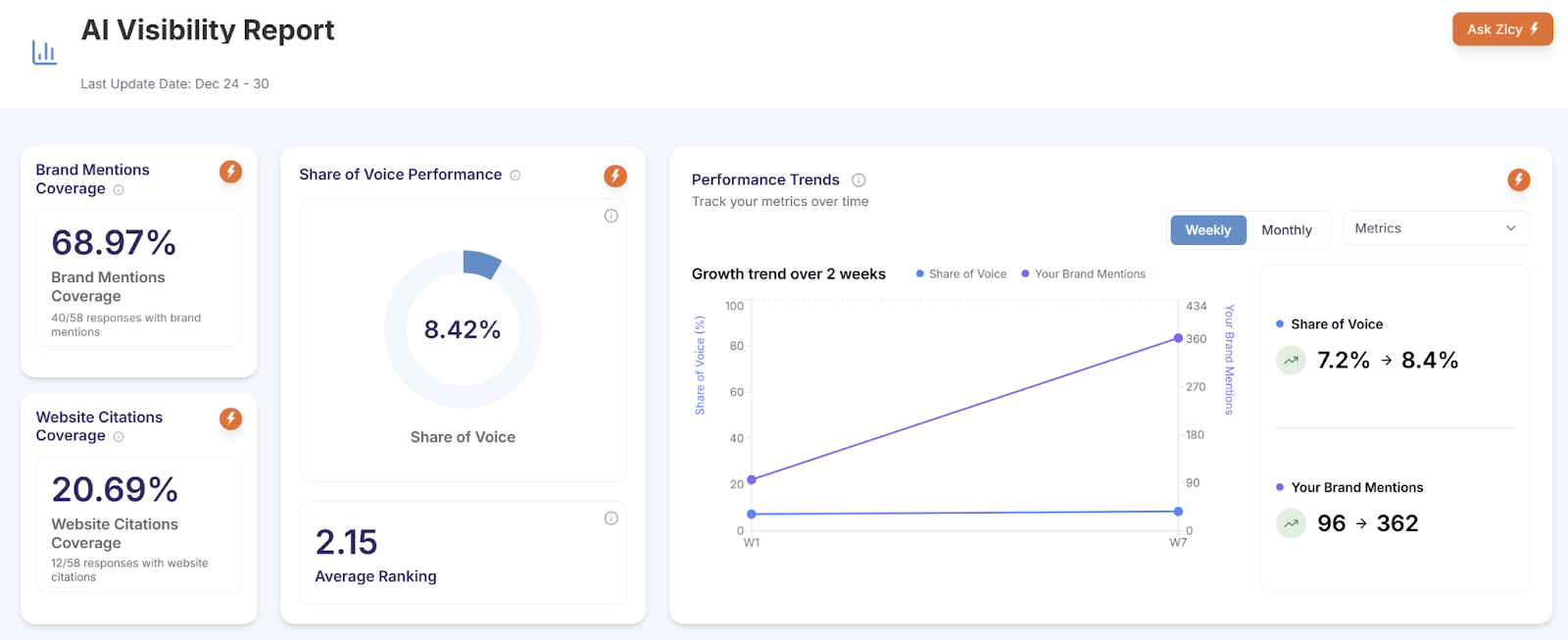
We baselined the brand across ChatGPT, Gemini, Perplexity, Google AI Overviews, and Google AI Mode. We mapped real shopping-style prompts that contact-lens buyers actually run. We benchmarked against five direct competitors.
The picture: meaningful presence on some priority queries, gaps in others, and a distinctive opportunity. The product pages themselves were the right target for citation work, not blog content or category-information pages.
What The Work Involved
The engagement ran across all four pillars of the PAVA Framework: Presence, Authority, Visibility, Amplification. Each pillar addresses a question AI platforms appear to weigh before deciding whether to surface a brand in an answer.
-
PRESENCE. Entity integrity.
Brand-product associations were tightened across the catalogue so AI could resolve specific product SKUs against the brand cleanly. Ambiguous category phrasing on product pages was rewritten. Schema deployment across organisation, product, offer, and review types audited and cleaned. Canonical brand description aligned across LinkedIn, Crunchbase, and the relevant retail directories. Wikipedia work went through the standard contributor process with paid-contributor disclosure where the policy requires it.
-
AUTHORITY. Earned editorial standing.
We mapped the third-party publications and review outlets AI cites in the contact-lens category. We briefed the brand’s existing PR and partnership team against that target list with angle briefs the firm could pursue on the merits of the work. Citation outcomes measured against each placement.
This is what AI Citation Enablement looks like on the earned side. AICE is the discipline we run across all four PAVA pillars: making the brand’s expertise easier for AI to find, verify, and accurately attribute, on the brand’s own merits.
-
VISIBILITY. Content architecture.
This was the centre of gravity for the engagement. We mapped the prompt universe, our term for the high-intent shopping-style prompts contact-lens buyers actually run on AI platforms. We then made an unusual call. Instead of building separate AI-targeted content pages, we restructured the product pages themselves into AI-extractable format.
Product pages were rebuilt for answer clarity rather than keyword density. AI-readable attributes were added: specific use cases, comparisons, transactional questions answered inline. Commercial-intent phrasing was balanced against the neutral, factual language LLMs tend to extract. Ambiguity was removed line by line.
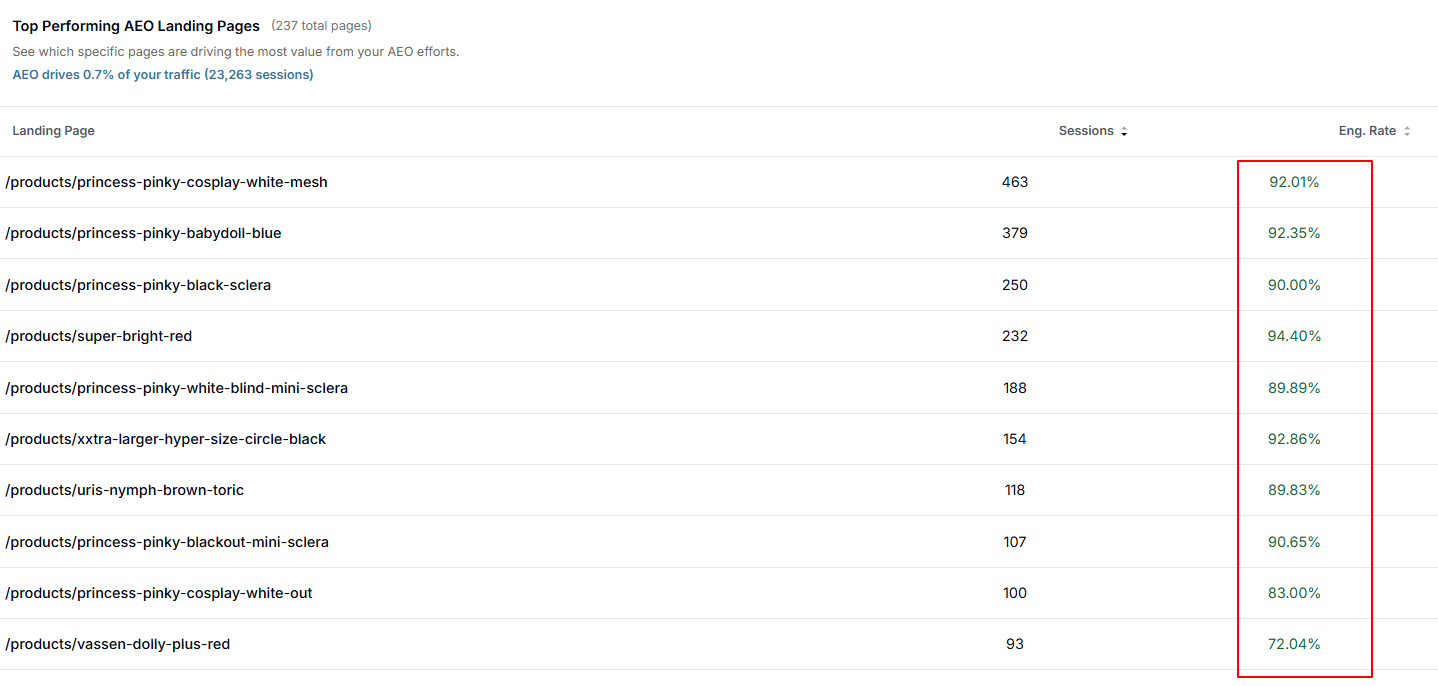
The bet was that AI would cite the product page itself if the product page resolved the buyer’s actual question. That bet paid off. AI-referred users landed directly on commercial product URLs, not blog content. The top landing pages held 89% to 94% engagement rates, the strongest engagement signal in the case library.

-
AMPLIFICATION. Sustained presence.
Continuous monitoring across all five named AI platforms. Ranking, mention, and citation patterns tracked over time. Sentiment patterns across cited sources watched continuously. AI-referred traffic attributed back to landing-page level via GA4 to verify which product pages AI was actually citing.
The Numbers
AI VISIBILITY METRICS:
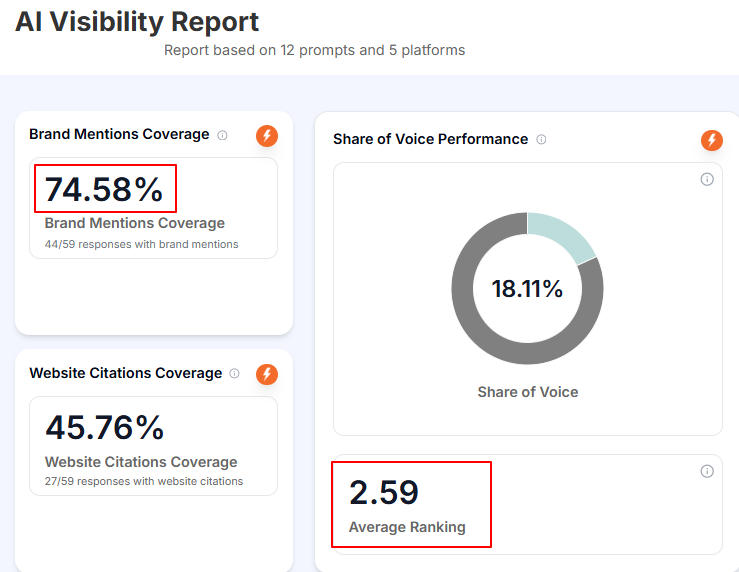
- Brand mention coverage: 74.58% (44 of 59 responses)
- Citation rate: 45.76%
- Share of voice: 18.11% (#1 among five competitors)
- Average AI ranking position: 2.59
AI TRAFFIC PERFORMANCE:
- AEO traffic growth rate: +1,207%
- Total site traffic growth rate: +21%
- AI traffic grew 57 times faster than total site traffic
- 96.6% of AI-driven traffic from ChatGPT
ENGAGEMENT QUALITY:
- AI-referred users landed on commercial product URLs, not blog content
- Top product pages: 89% to 94% engagement rates

We measure outcomes against what we call the M-C-R stack: Mention, Citation, Recommendation. This engagement moved Mention coverage to 74.58% and put the brand at the top of the category on share of voice. The 2.59 average ranking is consistent top-three. Recommendation rate, where the brand is the suggested choice in a commercial-intent answer, is the third tier and the next horizon for the measurement programme.
The signature finding is the engagement rate on AI-referred traffic. 89% to 94% on top product pages is buyer-grade. AI did the comparison work inside the chat window. Users landed on the product page already converted on the brand decision and most of the way down the funnel on the SKU decision. That is the commercial pattern this work is supposed to produce.
Three Observations
Product Pages Can Be The Cited Page.
The standard playbook in this category is to build separate informational content pages targeted at AI. That works, but it splits the traffic between informational visitors and commercial visitors. On this engagement, we restructured the product pages themselves into AI-extractable format. AI cited them directly. Users landed on commercial URLs. The engagement rates were 89% to 94% precisely because the buyer had been pre-qualified inside the chat window.
The Growth-rate Differential Is The Read, Not The Absolute Growth.
AEO traffic growing at 1,207% is impressive in isolation. AEO traffic growing 57 times faster than total site traffic is the structurally meaningful number. It tells you where attention is moving and at what speed. eCommerce CMOs measuring AI traffic only against itself miss this. The differential against total channel growth is the channel-allocation read.
Contact Lenses Are A Leading Indicator For How Consumables Work In AI Search.
Repeat purchases, brand-led shopping behaviour, comparison-heavy decision logic. The same pattern applies to most consumables in the AI search era. We are watching this category closely because it is structurally simpler than apparel or electronics, and the dynamics that work here will spread.
What Was Not In Scope
The work explicitly excluded several practices. This matters in 2026 because Google’s May 15 spam-policy update on generative search formally classified most of them as spam.
- No paid placements with passing links. Any sponsored editorial carried rel=”sponsored” or rel=”nofollow”.
- No syndicated press release distribution with optimised anchor text.
- No anonymous Wikipedia editing on the brand’s behalf.
- No AI-generated product descriptions published at scale.
- No incentivised or coordinated reviews on platforms AI reads.
These are not stylistic preferences. They are the line between sustainable AI visibility work and tactics that are about to be audited out of the market. In US-market eCommerce specifically, the FTC’s posture on incentivised review programmes is also tightening, which compounds the regulatory case for the disciplined approach.
In May we renamed our signature practice from “AI Citation Engineering” to “AI Citation Enablement”. The acronym (AICE) stayed, the framing changed. “Engineering” implies working on AI’s evaluation. “Enablement” describes working on the brand. The second framing is the only one I am comfortable defending in client engagements over the next two years.
Where To Start
If your eCommerce brand sells consumables and has not benchmarked AI visibility on its product pages specifically, that is the place to start. We run a complimentary AI Visibility Audit. It takes a week, produces a board-ready benchmark against your top competitors across all five major AI platforms, and surfaces whether AI is citing your product pages or your category-information pages. The audit is the diagnostic phase of the AI Visibility Operating System we build for consumer brands.
DM me if that is useful.