What The PAVA Framework Engagement Looks Like When SEO And AI Visibility Diverge.
An eCommerce client engaged us last quarter with a clean traditional analytics dashboard. Healthy organic traffic. Stable Google rankings. Steady conversion rate. The catch: competitors with weaker Google positions were being recommended more often inside AI platforms. Search performance looked fine. AI-driven discovery was completely invisible.
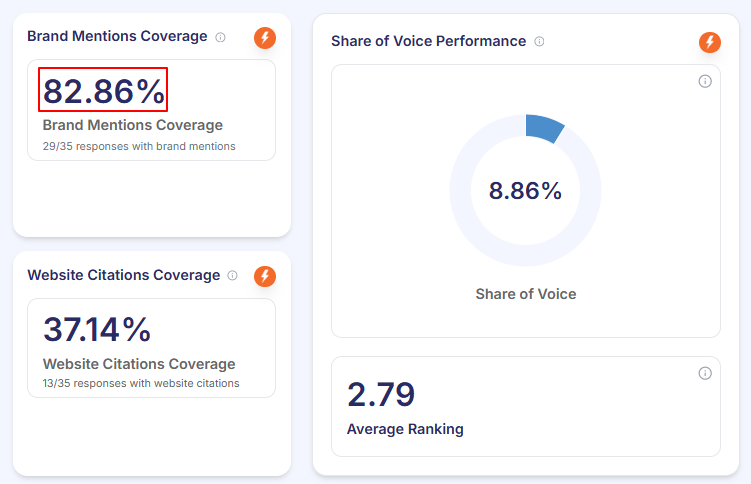
Across the engagement, the brand took the #1 share-of-voice position in its category at 8.86%, with 82.86% mention coverage and a 2.79 average AI ranking. The competitors that were outranking the brand on Google were behind in AI visibility.
Below is what the work involved, and what I would take from it.
The Starting Position
Most marketing dashboards in 2026 still report SEO and AI search as if they were the same channel. They are not. A brand can hold strong page-one Google positions and be invisible in AI answers, and a brand can be invisible on page one of Google but dominate AI summaries. The two systems weigh different signals.
This client was in the first situation. Traditional rankings were stable. AI presence was patchy. The category was being shaped by AI answers in a way the existing measurement programme could not see.
We baselined the brand across ChatGPT, Gemini, Perplexity, Google AI Overviews, and Google AI Mode. We mapped real buyer-style prompts. We benchmarked against five direct eCommerce competitors.
The picture was structural. AI was not simply rewarding the brands that ranked highest on Google. It was rewarding the brands with the clearest entity definition, the most extractable content, and the most consistent third-party validation across the sources AI reads.
What The Work Involved
The engagement ran across all four pillars of the PAVA Framework: Presence, Authority, Visibility, Amplification. Each pillar addresses a question AI platforms appear to weigh before deciding whether to surface a brand in an answer.
-
PRESENCE. Entity integrity.
Brand-product associations were tightened across the site so AI could confidently reference specific product categories to the brand. The ambiguous phrasing that was leading AI to cite “neutral” competitor descriptions was rewritten. Schema deployment audited and cleaned across product, organisation, and offer types. Canonical brand description aligned across LinkedIn, Crunchbase, and the relevant retail directories. Wikipedia work went through the standard contributor process with paid-contributor disclosure where the policy requires it. -
AUTHORITY. Earned editorial standing.
We mapped the third-party publications AI platforms cite in this product category. We briefed the brand’s existing PR and partnership team against that target list with angle briefs the firm could pursue on the merits of the work. Citation outcomes measured against each placement.This is what AI Citation Enablement looks like on the earned side. AICE is the discipline we run across all four PAVA pillars: making the brand’s expertise easier for AI to find, verify, and accurately attribute, on the brand’s own merits.
-
VISIBILITY. Content architecture.
We mapped the prompt universe, our term for the high-intent commercial and evaluative queries the brand’s buyers actually run on AI platforms. Tracked prompts were mapped against product and category pages. Owned content was restructured into the formats AI retrieval systems extract most reliably: direct answers at the top of product pages, comparison-logic framing on collection pages, clear differentiation cues, and statistics sourced with publisher, sample, and year where applicable.

-
AMPLIFICATION. Sustained presence.
Continuous monitoring across all five named AI platforms. Movement in rankings and mentions tracked over time. Validation of every optimisation by measurable deltas, not assumptions. Competitor density per prompt monitored, with reinforcement work scheduled wherever a competitor was gaining ground.
The Numbers
AI VISIBILITY METRICS:
- Brand mention coverage: 82.86%
- Citation rate: 37.14%
- Share of voice: 8.86% (#1 in category against five competitors)
- Average AI ranking position: 2.79
- Multiple prompts achieving 5/5 brand mention coverage and top-3 AI positions
COMPETITIVE POSITIONING:
- #1 in share of voice against five direct eCommerce competitors
- Outperformed competitors on brand mentions, citation presence, and AI recommendation visibility
- Several competitors held stronger Google rankings; brand outperformed them in AI

We measure outcomes against what we call the M-C-R stack: Mention, Citation, Recommendation. This engagement moved Mention coverage to 82.86% and put the brand at the top of the category on share of voice. The 2.79 average ranking position is consistent top-three. Recommendation rate, where the brand is the suggested choice in a commercial-intent answer, is the third tier and the next horizon for the measurement programme.
The structural finding from this engagement was the SEO–AI divergence. Page-one Google rankings did not predict AI visibility, and competitors that held weaker Google positions outperformed in AI answers when their entity definition and content extractability were better. The two channels need to be measured as separate systems.
Three Observations
Google Rankings And AI Visibility Are Two Different Systems Now.
The Ahrefs data from 2025 showed it at scale: only 12% of AI-cited links also rank in Google’s top 10. This engagement showed it on a single brand. Strong Google performance is not a substitute for AI visibility work, and the inverse is increasingly common. eCommerce CMOs measuring only Google rankings are flying blind in roughly the same way CMOs in 2010 were flying blind on social.
Ambiguity Is The Easiest Problem To Fix, And The Most Commonly Ignored.
On this engagement, the largest single intervention by impact was removing ambiguous brand-product phrasing that was causing AI to cite “neutral” descriptions of the category instead of naming this brand specifically. That is a content-clarity gap, not an authority gap. The brand had the standing. The signals were not clean.
#1 Share Of Voice Is The Categorical Leadership Read, Not Mention Rate.
The brand reached 82.86% mention coverage, which is a strong number. The more important read is the 8.86% share of voice, which placed the brand at #1 among five direct competitors. In competitive eCommerce categories, the absolute mention rate matters less than the ratio against the competitive set. Share of voice is the read.
What Was Not In Scope
The work explicitly excluded several practices. This matters in 2026 because Google’s May 15 spam-policy update on generative search formally classified most of them as spam.
- No paid placements with passing links. Any sponsored editorial carried rel=”sponsored” or rel=”nofollow”.
- No syndicated press release distribution with optimised anchor text.
- No anonymous Wikipedia editing on the brand’s behalf.
- No AI-generated content published at scale, including product descriptions.
- No incentivised or coordinated reviews on platforms AI reads.
These are not stylistic preferences. They are the line between sustainable AI visibility work and tactics that are about to be audited out of the market.
In May we renamed our signature practice from “AI Citation Engineering” to “AI Citation Enablement”. The acronym (AICE) stayed, the framing changed. “Engineering” implies working on AI’s evaluation. “Enablement” describes working on the brand. The second framing is the only one I am comfortable defending in client engagements over the next two years.
Where To Start
If your eCommerce brand is performing well on Google but you have not benchmarked AI visibility separately, that gap is the single most common blind spot in consumer-brand marketing right now. We run a complimentary AI Visibility Audit. It takes a week, produces a board-ready benchmark against your top competitors across all five major AI platforms, and surfaces the SEO–AI divergence on the priority prompt set. The audit is the diagnostic phase of the AI Visibility Operating System we build for consumer brands.
DM me if that is useful.